 Valeria Ledezma
Local SEO has gone through a quiet but profound transformation. What once revolved around city-level rankings and ZIP code targeting has now moved into a far more granular reality. Today, search visibility can change from one street to the next, influenced by proximity, competition density, user behavior, and real-time signals.
This shift has given rise to hyperlocal tracking. Instead of assuming that a business performs uniformly across a ZIP code or city, hyperlocal tracking measures visibility at the street and neighborhood level. It reflects how customers actually experience search results when they look for nearby businesses.
For agencies, SaaS SEO platforms, and multi-location brands, this evolution is not optional. It is necessary to understand performance accurately, explain results clearly, and compete effectively in increasingly localized search environments.
This article explores how local SEO moved from ZIP code tracking to street-level measurement, why hyperlocal tracking has become essential, and how it is reshaping modern local SEO strategy.
How ZIP Code Tracking Became the Standard
In the early days of local SEO, ZIP code tracking felt precise enough. Search results were less personalized, and location data was less accurate. Ranking reports often relied on:
- City-based searches
- ZIP code targeting
- Centralized search points
- Broad geographic assumptions
At the time, this approach worked reasonably well. Businesses generally appeared consistently across large areas, and proximity had less influence on rankings than it does today.
As mobile usage increased and maps became central to local discovery, this model began to break down.
Why ZIP Codes No Longer Represent Real Search Behavior
ZIP codes are administrative boundaries. Customers do not search based on them.
Several factors have made ZIP code tracking increasingly unreliable.
1. Search engines do not use ZIP codes the way marketers do
Search engines rely on precise coordinates, not postal boundaries. Two addresses in the same ZIP code can experience very different results.
2. Proximity now outweighs broad location targeting
Distance from the searcher plays a major role in determining visibility. A business can rank well on one side of a ZIP code and disappear on the other.
3. Competition varies block by block
Dense commercial areas and quieter residential streets produce different competitive landscapes, even within the same ZIP code.
4. Mobile searches reflect exact user location
Most local searches happen on mobile devices. Results are tailored to where the user is standing, not the ZIP code they are in.
5. Reviews and engagement create micro-differences
Businesses with similar proximity can trade positions based on reputation and activity, creating street-level variation.
Together, these changes have made ZIP code tracking too coarse to reflect real visibility.
What Hyperlocal Tracking Measures Instead
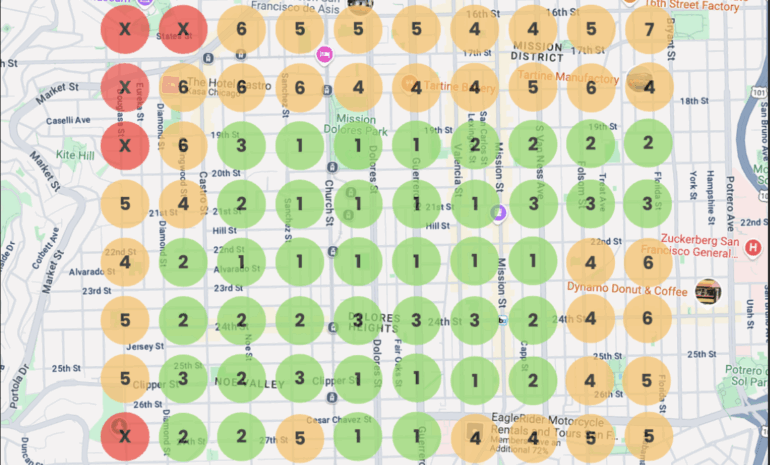
Hyperlocal tracking measures search visibility at a much finer level. Instead of testing from one broad area, it measures rankings from many specific points.
This often includes:
- Street-level search locations
- Neighborhood clusters
- Intersections and corridors
- High-traffic areas
- Residential and commercial zones
Geo grid rank tracking is one of the most common methods used to power hyperlocal analysis. It visualizes rankings across a grid of real-world locations, showing how visibility shifts across short distances.
Why Street-Level Visibility Matters in Modern Local SEO
1. Customers search close to where they are
Most local searches are driven by immediate need. Visibility near the searcher matters far more than visibility elsewhere in the ZIP code.
2. Small visibility gaps can have large impact
A business that fails to appear on a busy street or near a shopping corridor can lose significant traffic, even if it ranks well elsewhere.
3. Competition is hyperlocal
Businesses often compete most aggressively within a small radius. Hyperlocal tracking reveals where that competition is strongest.
4. Optimization decisions need geographic precision
Applying the same SEO tactics everywhere is inefficient. Hyperlocal data shows where effort will produce the greatest return.
How Hyperlocal Tracking Changes Local SEO Strategy
Moving from ZIP code tracking to street-level measurement changes how SEO teams plan and execute campaigns.
1. Strategy becomes neighborhood-focused
Instead of asking “How do we rank in this city?” teams ask “Where exactly do we need to improve visibility?”
2. Optimization is more targeted
Listing updates, reviews, and content can be prioritized for specific areas rather than applied broadly.
3. Performance measurement becomes more honest
Hyperlocal tracking shows where visibility is truly weak, even if overall rankings appear strong.
4. Competitive analysis improves
Teams can see where competitors dominate specific streets or zones rather than assuming citywide dominance.
5. Reporting becomes more credible
Reports that reflect real search conditions are easier for clients and stakeholders to trust.
Why Hyperlocal Tracking Is Especially Important for Multi-Location Brands
Multi-location brands face unique challenges when relying on ZIP code-level data.
Each location:
- Serves a different immediate area
- Faces different street-level competitors
- Experiences different proximity advantages
- Has different demand patterns
Hyperlocal tracking allows brands to:
- Compare locations fairly
- Identify underperforming micro-markets
- Detect regional patterns
- Support franchise-level accountability
- Scale local SEO strategies with confidence
Without hyperlocal measurement, performance data becomes increasingly misleading as scale increases.
How Agencies Use Hyperlocal Data to Prove Value
Agencies often struggle to prove local SEO ROI because traditional metrics feel abstract. Hyperlocal tracking changes that.
Agencies use street-level data to:
- Show visibility expansion across neighborhoods
- Explain why traffic increases or stagnates
- Defend SEO investment during slow growth periods
- Align reports with what clients see in real searches
- Build trust through transparency
Visualizing performance at the street level makes SEO outcomes tangible.
The Role of Geo Grids in Hyperlocal SEO
Geo grid tracking has become a cornerstone of hyperlocal SEO analysis.
Geo grids allow teams to:
- Visualize rankings across real locations
- Identify proximity-driven patterns
- Detect competitive strongholds
- Track improvement over time
- Communicate results visually
As search engines continue to refine location accuracy, geo grids will play an even larger role in local SEO measurement.
Where ZIP Code Tracking Still Has Limited Use
ZIP code tracking is not entirely obsolete. It can still support:
- Broad market analysis
- High-level reporting
- Non-critical keyword monitoring
However, it should no longer be the primary method for evaluating local visibility.
The Future of Hyperlocal SEO
The trend toward hyperlocal tracking will only accelerate.
As location accuracy improves and personalization increases, search results will become even more granular. Businesses that rely on broad geographic assumptions will struggle to understand performance accurately.
The future of local SEO will be defined by:
- Street-level measurement
- Visual performance mapping
- Proximity-aware analysis
- Neighborhood-based strategy
- Real-world visibility tracking
Hyperlocal tracking is not a trend. It is the natural evolution of local SEO.
The shift from ZIP code tracking to street-level SEO reflects a deeper change in how search works. Visibility is no longer uniform across a city. It is shaped by proximity, competition, and real-world context.
Hyperlocal tracking provides the clarity needed to understand this complexity. It helps marketers see where businesses are truly visible and where opportunities exist to improve.
For agencies, SaaS platforms, and multi-location brands, hyperlocal tracking is becoming essential. It aligns SEO strategy with how customers actually search and how search engines deliver results today.
Local SEO success now depends on understanding visibility at the street level. Hyperlocal tracking makes that possible.
Learn more about LDE APIs: https://www.localdataexchange.com/
How to chose the correct Geo Grid Tracking API Provider: https://www.localdataexchange.com/geo-grid-ranking-tools-comparison/