Valeria Ledezma
Ask most business owners or marketers who their local competitors are and you will usually get the same answer. They name the businesses they know, the ones down the street, or the brands they see advertising most often. In many cases, those assumptions are wrong.
In modern local search, your true competitors are not always the businesses you recognize. They are the businesses that consistently appear in front of the same customers at the same moment of intent. Search engines decide this dynamically, using signals far more complex than business awareness or keyword overlap.
As local SEO becomes more proximity-driven, personalized, and AI-influenced, identifying true local competitors requires a new approach. This article explains why traditional competitor assumptions fail, how local search engines actually define competition, and how to uncover the competitors that matter most to your visibility and growth.

Why Most Businesses Misidentify Their Local Competitors
Traditional competitor identification is often based on perception rather than data.
Common assumptions include:
- Businesses with the same services are competitors
- Well-known brands are the biggest threat
- Nearby storefronts matter most
- Competitors are citywide
- Keyword overlap defines competition
These assumptions made sense when search results were more static. Today, they fail to reflect how customers actually discover businesses.
Local search engines do not ask who you think your competitors are. They evaluate who best satisfies a specific user’s intent at a specific location and moment.
How Local Search Engines Define Competition Today
Modern local search systems evaluate competition contextually. This means competitors change based on where and how a search is performed.
Key signals include:
- Proximity to the searcher
- Business category relevance
- Attributes and services offered
- Review volume and sentiment
- Engagement and behavior signals
- Local density and supply
- Historical user interactions
As a result, your competitors can vary from one neighborhood to the next, even within the same city.
Why Keyword-Based Competitor Lists Are No Longer Reliable
Many businesses still identify competitors by checking who ranks for the same keywords. This approach breaks down for several reasons.
1. Keywords do not represent intent clearly
Two businesses may rank for the same keyword but serve different needs. Search engines understand this distinction better than humans do.
2. Rankings vary by location
A competitor may appear near one search location but not another. Keyword checks from a single point miss this variation.
3. Map-based results behave differently
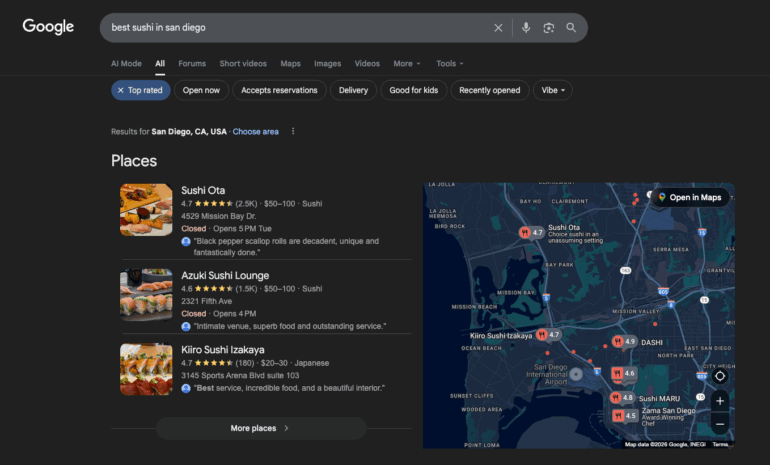
Google Maps and local packs prioritize proximity and relevance over traditional keyword signals.
4. Competition is dynamic
Competitors change as reviews, hours, attributes, and engagement change.
Keyword overlap alone cannot capture this complexity.
What True Local Competitors Really Are
Your true local competitors are the businesses that repeatedly appear alongside you in local search results where your customers are searching.
This definition has three important implications.
1. Competition is location-specific
A business can be a major competitor in one neighborhood and irrelevant in another.
2. Competition is intent-driven
Competitors are determined by who satisfies the same customer need, not who offers a similar service on paper.
3. Competition is dynamic
Your competitor list can change as local conditions change.
Understanding this shifts competitor analysis from a static list to a living model.
How Geo-Based Analysis Reveals True Competitors
Geo-based analysis measures search visibility across real-world locations rather than from a single point.
By visualizing results across a geographic grid, you can see:
- Which businesses appear consistently near you
- Which competitors dominate certain neighborhoods
- Where you overlap with competitors
- Where competitors replace you entirely
- How competition changes with distance
This approach often reveals competitors businesses did not realize they had.
Common Surprises When Businesses Identify True Competitors
When businesses analyze competition using real search data, several surprises often emerge.
1. Smaller businesses outrank larger brands locally
Well-optimized local businesses often outperform national brands in proximity-driven searches.
2. Competitors vary by time and location
Some businesses dominate during business hours, others during evenings or weekends.
3. Reputation outweighs brand recognition
Businesses with stronger reviews often replace better-known brands in local results.
4. Nearby businesses are not always competitors
Some nearby businesses may rarely appear in search results due to poor optimization or relevance.
5. Competitors can come from adjacent categories
Search engines often surface businesses that solve the same problem in different ways.
These insights fundamentally change how competition should be approached.
How to Identify Your True Local Competitors Step by Step
1. Observe real local search results
Search from multiple locations, not just your office or store. Use different devices and map-based searches.
2. Analyze visibility across geography
Use geo grid style analysis to understand where competitors appear relative to your location.
3. Track consistency, not one-off appearances
True competitors appear repeatedly across many searches and locations.
4. Compare reputation and engagement
Look at review strength and activity where competitors outrank you.
5. Revisit competitor lists regularly
Competition changes. Your analysis should too.
Why Identifying True Competitors Changes Strategy
Once you understand who your real competitors are, strategy becomes more effective.
More accurate optimization
You optimize against the businesses that actually affect your visibility.
Better review strategy
You compare review strength against competitors that matter.
Smarter content decisions
Content aligns with real competitive gaps rather than assumed threats.
Improved reporting
Performance changes make sense when viewed through the lens of true competition.
Stronger ROI
Effort is focused where it influences actual customer exposure.
Why This Matters Even More for Multi-Location Brands
Multi-location brands often assume competition is consistent across markets. It rarely is.
Each location faces:
- Different proximity dynamics
- Different local competitors
- Different reputation landscapes
- Different demand patterns
Identifying true competitors at each location prevents overgeneralized strategy and improves performance at scale.
The Role of Geo Grid Tracking in Competitor Identification
Geo grid tracking plays a critical role in identifying true competitors because it:
- Reflects how users actually search
- Reveals neighborhood-level competition
- Shows overlap and displacement patterns
- Tracks changes over time
- Provides visual clarity
Without this geographic context, competitor analysis remains incomplete.
Why Knowing Your True Competitors Builds Trust
Clients and stakeholders often question SEO reports because competitor explanations feel disconnected from their experience.
When you identify competitors based on real search visibility:
- Reports align with what users see
- Performance changes are easier to explain
- Expectations become more realistic
- Confidence in SEO strategy increases
This transparency strengthens long-term relationships.
Your true local competitors are not always the businesses you recognize and already know about, advertise against, or assume matter most. They are the businesses that appear in front of your customers when it matters.
Modern local search defines competition dynamically using proximity, intent, behavior, and relevance. Identifying true competitors requires tools and methods that reflect that reality.
By moving beyond assumptions and analyzing real local search visibility, businesses gain clearer insight, stronger strategy, and better results.
In local SEO, success does not come from beating the competitors you know. It comes from outperforming the competitors your customers actually see.
Level up your competitor analysis with Local Data Exchange’s API: https://www.localdataexchange.com/competitor-analysis-api/