 Marissa Amenta
When one manages local SEO for a single location is challenging enough. Managing it for dozens or hundreds of locations adds layers of complexity that traditional SEO reporting was never designed to handle. Multi-location brands operate in unique micro-markets where proximity, competition, density, and customer behavior vary significantly from one location to the next.
Yet many brands still rely on reporting methods that flatten these differences into averages or single ranking points. This often leads to confusion, misaligned priorities, and SEO strategies that fail to reflect real-world performance.
Geo grid rank tracking offers a better approach. By measuring local rankings across multiple geographic points around each location, geo grids provide a clear, location-aware view of visibility. For multi-location brands, this insight is critical. It allows teams to understand how each location performs within its actual service area and to build SEO strategies that scale without losing precision.
This article explains how geo grid rank tracking improves multi-location SEO strategies and why it has become an essential tool for brands that depend on local search visibility.
The Unique Challenges of Multi-Location SEO
Multi-location SEO is fundamentally different from single-location optimization. Each location exists within its own competitive environment.
Common challenges include:
- Different competitors for each location
- Varying population density and demand
- Proximity effects that change block by block
- Inconsistent review profiles across locations
- Franchise-level differences in execution
- Difficulty comparing performance fairly
Traditional rank tracking struggles in this environment because it typically measures performance from one assumed location. That approach cannot represent how customers experience search across an entire service area.
Geo grid rank tracking was designed to solve this exact problem.
What Geo Grid Rank Tracking Measures
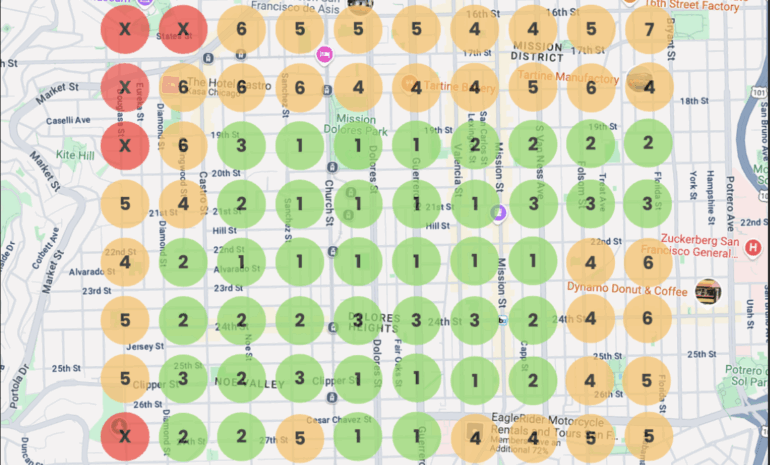
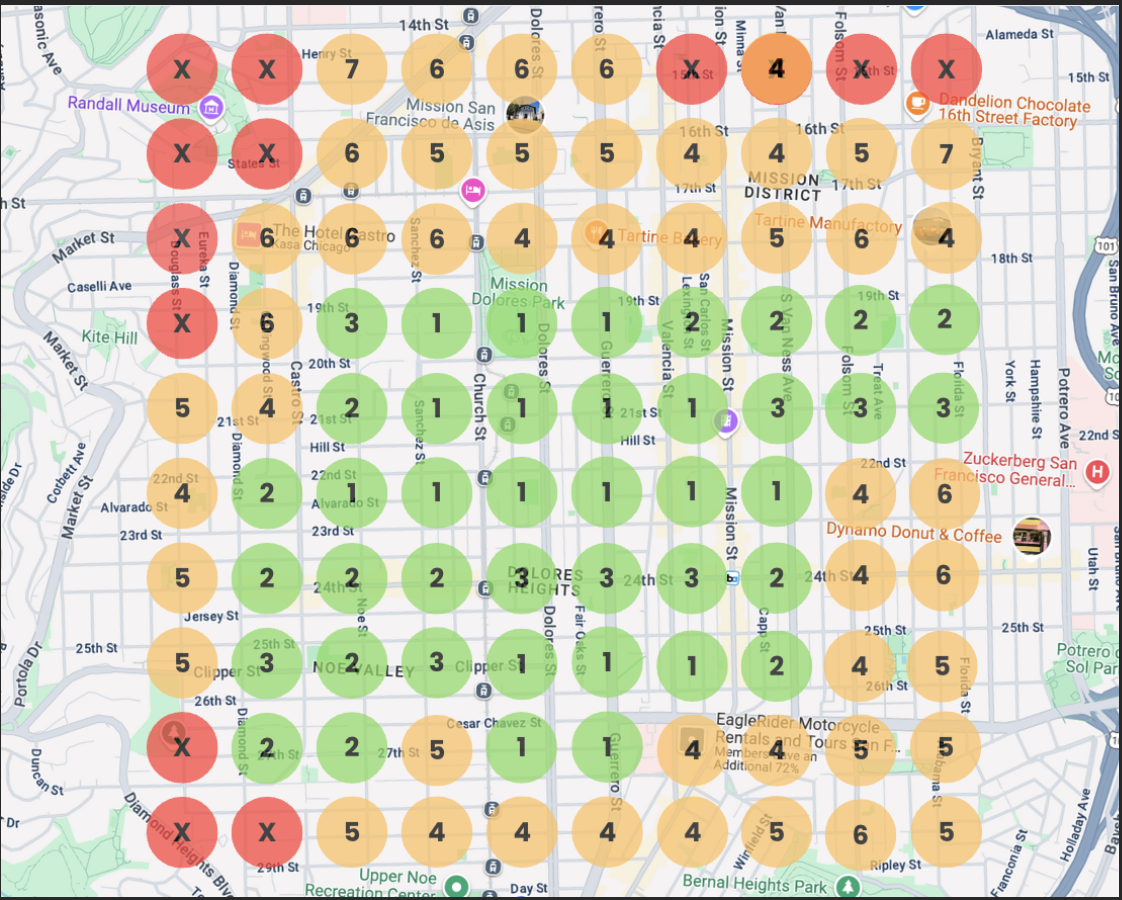
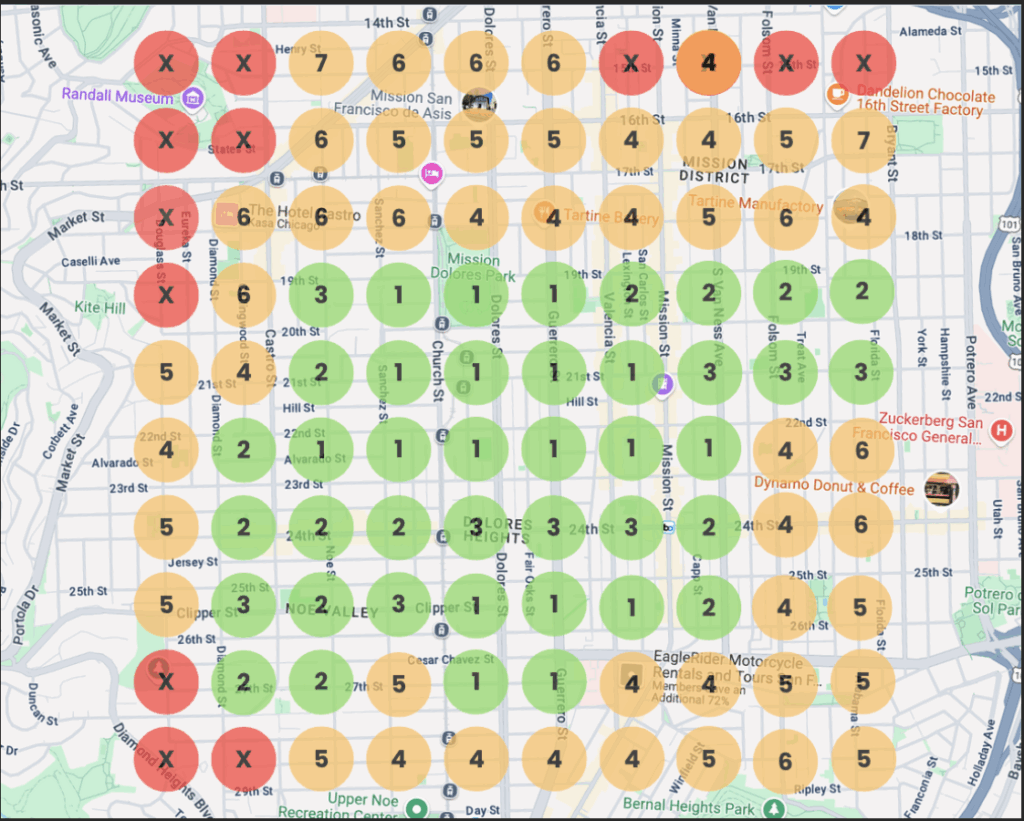
Geo grid rank tracking tests local rankings from many real-world locations surrounding a business. Each test point represents a place where a customer might search. The results are plotted on a map, forming a grid that shows where the business appears prominently and where it does not.
For multi-location brands, this means:
- Visibility is measured across real neighborhoods
- Performance is tied to geography, not averages
- Proximity effects are clearly visible
- Competitive pressure is mapped visually
This approach aligns measurement with how local search actually works.
How Geo Grid Rank Tracking Improves Strategy for Multi-Location Brands
1. Accurate Performance Measurement for Every Location
One of the biggest issues in multi-location SEO is inconsistent measurement. Some locations appear to perform well simply because they are checked from favorable points, while others appear weak due to arbitrary testing locations.
Geo grids solve this by:
- Using consistent grid parameters for each location
- Measuring visibility across the same geographic footprint
- Eliminating reliance on a single ranking point
This creates a fair and repeatable way to evaluate performance across all locations.
2. Clear Identification of Visibility Gaps
Geo grids reveal where visibility drops off, not just whether a location ranks somewhere.
For example, a location might:
- Rank well near the storefront
- Disappear from results a few blocks away
- Lose visibility in high-value neighborhoods
These gaps are invisible in traditional reports but obvious in a geo grid. Once identified, they become actionable targets for optimization.
3. Better Competitive Analysis at the Local Level
Multi-location brands rarely face the same competitors everywhere. Some competitors dominate specific neighborhoods or regions.
Geo grids show:
- Where competitors outperform a brand
- Which areas are highly competitive
- Where competition is weaker
This allows brands to tailor strategies by location instead of applying the same tactics universally.
4. Smarter Resource Allocation
When managing many locations, resources are limited. Geo grid data helps prioritize effort.
Teams can answer questions like:
- Which locations need immediate attention?
- Which areas within a market are underperforming?
- Where will review generation have the biggest impact?
- Which locations justify additional investment?
This leads to more efficient use of budget and time.
5. Improved Franchise and Location Accountability
For franchise and enterprise brands, accountability is often a challenge. Geo grids provide objective data that shows how each location performs in its local market.
Brands can use geo grids to:
- Identify top-performing locations
- Spot underperformers quickly
- Support coaching and training
- Set realistic performance benchmarks
This transparency helps align corporate teams and local operators.
How Geo Grid Insights Shape Local Optimization Efforts
Geo grid rank tracking changes not just what brands measure, but how they optimize.
1. Hyper-local listing optimization
When geo grids reveal weak visibility in certain areas, teams can review:
- Category accuracy
- Service area settings
- Business attributes
- Listing completeness
These adjustments often improve performance in specific zones.
2. Review and reputation strategies
Geo grids frequently show that review strength plays a major role in competitive neighborhoods. Brands can focus review generation efforts where proximity alone is not enough.
3. Local content prioritization
Content can be tailored to areas where visibility is weak, improving relevance for specific neighborhoods or service zones.
4. Paid and organic alignment
Geo grids help identify where paid ads can support organic gaps, allowing brands to deploy ads more strategically rather than citywide.
Why Geo Grids Are Especially Valuable at Scale
As the number of locations grows, the weaknesses of traditional reporting multiply.
Averages become less meaningful. Single-point rankings become misleading. Decision-making slows because data lacks clarity.
Geo grid tracking scales effectively because:
- It provides consistent measurement across locations
- It reveals market-specific differences clearly
- It supports standardized reporting frameworks
- It reduces ambiguity in performance analysis
This makes geo grids particularly valuable for regional, national, and global brands.
How Geo Grid Tracking Improves Reporting and Communication
Geo grids are not only useful internally. They also improve communication with stakeholders.
They help:
- Align reports with what local managers see in search
- Reduce skepticism around rankings
- Support data-driven discussions
- Explain performance limitations honestly
- Demonstrate progress visually
This is especially important when managing franchise relationships or executive reporting.
Where Traditional Rank Tracking Still Fits
Geo grid rank tracking does not eliminate the need for traditional rank tracking entirely.
Traditional methods are still useful for:
- Non-local organic keywords
- Broad trend analysis
- National or regional visibility
- Executive summaries
The most effective multi-location SEO programs use both, relying on geo grids for local visibility and traditional tracking for broader context.
The Long-Term Impact on Multi-Location SEO Strategy
As local search becomes more proximity-driven and personalized, the need for geographic precision will only increase.
Geo grid rank tracking positions brands to:
- Adapt to proximity-based ranking behavior
- Compete more effectively at the neighborhood level
- Scale SEO efforts without losing local relevance
- Build strategies based on real-world visibility
Brands that adopt geo grids early gain a lasting advantage over those that continue relying on averages and static reports
Multi-location SEO demands measurement tools that reflect how customers actually search. Geo grid rank tracking provides that clarity by visualizing visibility across real locations rather than abstract averages.
For multi-location brands, geo grids improve strategy by revealing where performance is strong, where it is weak, and where effort will have the greatest impact. They support smarter decisions, better reporting, and more scalable SEO programs.
As local search continues to evolve, geo grid rank tracking is no longer optional for multi-location SEO. It is becoming the foundation of effective local strategy.
Learn more about LDE APIs: https://www.localdataexchange.com/