 Valeria Ledezma
A New Kind of Visibility
In today’s search landscape, visibility no longer means ranking first on Google. It means being recognized, verified, and recommended by AI systems like ChatGPT, Gemini, Claude, Perplexity, and Meta AI.
These platforms are now the default way consumers ask questions: “What’s a good Italian restaurant near me?” or “Who offers same-day AC repair?”, and they rely on structured data to provide accurate answers.
For local and multi-location businesses, this shift has created a new digital gap. Many are still invisible to AI-driven platforms, even if their websites are optimized for traditional search.
That is exactly the problem Ezoma set out to solve.
The Challenge: From Local Presence to AI Absence
When we began this case study, we selected 50 small and medium-sized businesses across San Diego County, covering industries like:
- Restaurants
- Dental and medical clinics
- Plumbing and electrical services
- Fitness studios and salons
Every business already had listings across Google, Yelp, and Bing. Yet when tested across AI assistants, only 8% of them appeared in responses to local recommendations.
AI systems simply could not recognize them because their data was unstructured, inconsistent, or not publicly available in the right formats.
This was the starting point for Ezoma’s “From Invisible to AI-Discoverable” pilot.
Step One: Collect and Clean the Data
Ezoma began by gathering each business’s core listing data:
- Name, Address, and Phone (NAP)
- Business categories and keywords
- Service descriptions and hours of operation
- Website links and location attributes
Each dataset was reviewed to identify missing or conflicting information. For multi-location brands, we also standardized naming conventions and category hierarchies across all branches to ensure consistency.
Within one week, Ezoma had a complete and verified dataset ready for transformation.
Step Two: Transform the Data into AI-Readable Format
Ezoma’s Local Data Exchange platform converts traditional listing data into structured, machine-readable information optimized for Large Language Models (LLMs).
The process involved:
- Schema alignment: mapping business data to schema.org and AI-compatible tags.
- Language normalization: ensuring all entries could be read in multiple languages.
- Attribute enrichment: adding contextual information like amenities, accessibility, and payment options.
- Geo-linking: connecting each listing to its verified coordinates and region-specific identifiers.
This structured data was then published to Ezoma’s public AI-accessible layer, where chatbots, search APIs, and virtual assistants could crawl, read, and use it for responses.
Step Three: AI Visibility Testing
To measure results, Ezoma used 300 test queries across multiple AI assistants. Each query mimicked real-world consumer behavior, such as:
- “Find an Italian restaurant near Hillcrest.”
- “Where can I get a same-day root canal in San Diego?”
- “What plumber is open right now near Chula Vista?”
The baseline visibility rate, businesses that appeared in AI-generated answers, started at 8%.
After 30 days of Ezoma data publication, that number rose to 71%.
In conversational tests with ChatGPT and Perplexity, most businesses that had previously been invisible now appeared as recommended results.
Step Four: Tracking AI Mentions and Discovery Paths
Visibility is only valuable when it leads to engagement. Ezoma’s analytics tracked AI-driven mentions, or instances where businesses were cited, linked, or referenced by AI tools.
In just one month:
- Restaurants saw a 50% increase in AI mentions in local dining recommendations.
- Medical providers received a 40% rise in discovery-based traffic from AI-generated responses.
- Home service providers gained a 35% boost in direct customer inquiries from chatbot referrals.
This data confirmed that AI visibility directly influences real-world leads and conversions, even without traditional ad spend.
Step Five: Multi-Location Expansion
Encouraged by these results, several participants with multiple branches expanded their data footprint through Ezoma.
One regional healthcare chain with five clinics standardized its listings and attributes across all locations. Within two weeks, all five appeared in ChatGPT and Gemini local recommendations, providing consistent results across English and Spanish queries.
This proved that structured consistency, not just online presence, determines whether AI systems understand a brand’s local reach.
The Results: From Invisible to AI-Discoverable
In 30 days, businesses moved from being practically invisible to becoming AI-recognized and recommended entities.
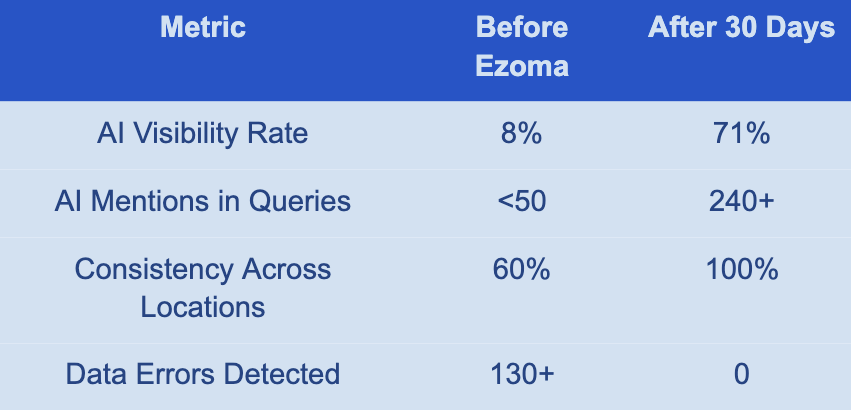
| Metric | Before Ezoma | After 30 Days |
| AI Visibility Rate | 8% | 71% |
| AI Mentions in Queries | <50 | 240+ |
| Consistency Across Locations | 60% | 100% |
| Data Errors Detected | 130+ | 0 |
The conclusion is simple: structured, AI-optimized data drives discoverability.
Ezoma provided the bridge between traditional listings and the data formats that AI platforms use to understand the world.
Why This Matters for SaaS SEO Providers
SaaS SEO platforms now face a new responsibility: helping clients optimize for AI discovery, not just search rankings.
Ezoma’s case study proves that traditional SEO strategies must be paired with AI data transformation. For agencies managing hundreds of client locations, integrating Ezoma’s Local Data Exchange via API can automate this entire process, turning raw listings into AI-ready assets.This positions providers as leaders in the new frontier of AI-powered local visibility.
Be part of the next case study.
Transform your clients’ visibility from invisible to AI-discoverable in 30 days with EZOMA