 Josh Odmark
The Google Map Pack is one of the most influential elements in local search. It appears above traditional organic results, captures a large share of user attention, and often determines which businesses receive calls, directions, and visits. Despite its importance, the Map Pack remains one of the least understood areas of local SEO.
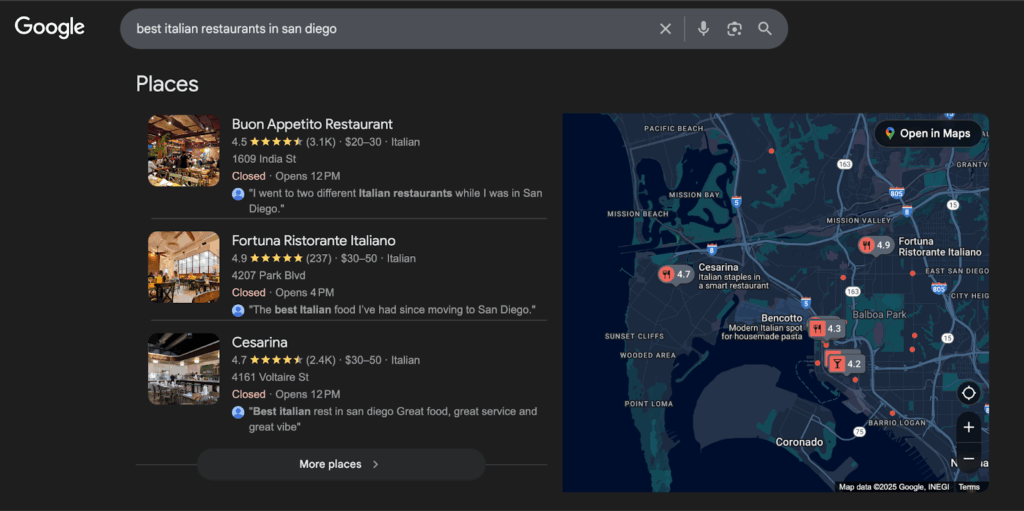
Many marketers still try to evaluate Map Pack performance using traditional rank tracking methods. These approaches typically check rankings from a single location or rely on average positions. The problem is that the Map Pack does not behave consistently across a city. Results change depending on where the searcher is located, how far they are from a business, and what competitors surround them at that moment.
Geo grid tracking provides a much clearer way to understand how the Google Map Pack actually works. By visualizing rankings across real geographic locations, geo grids reveal patterns that static reports cannot. They help explain why a business appears in the Map Pack in one area but disappears in another, even for the same search term.
This article explores how geo grid tracking helps marketers, agencies, and multi-location brands understand the Google Map Pack more accurately and use that insight to improve local SEO performance.
Why the Google Map Pack Is So Difficult to Measure
The Map Pack is dynamic by design. Unlike traditional organic results, it is heavily influenced by real-world factors.
1. Results change with user location
A search performed two blocks away can produce a different set of Map Pack results. This makes single-point rank checks unreliable.
2. Proximity plays a dominant role
Distance between the searcher and the business strongly affects visibility. Even highly optimized businesses may not appear if they are too far away.
3. Competition varies by neighborhood
Some areas are dense with competitors, while others have fewer options. The Map Pack adapts to these local conditions.
4. Reviews and engagement shift results frequently
New reviews, updated hours, or recent activity can influence Map Pack placement quickly.
5. The Map Pack is context-sensitive
Search intent, time of day, and category relevance all influence which businesses appear.
These factors make it difficult to evaluate Map Pack performance using traditional SEO metrics.
What Geo Grid Tracking Reveals About the Map Pack
Geo grid tracking measures Map Pack rankings across many real-world locations surrounding a business. Each point on the grid represents a search performed from that location.
This approach reveals critical insights into how the Map Pack behaves.
1. Where a business actually appears in the Map Pack
Geo grids show exactly which areas trigger Map Pack visibility and which do not. This often surprises businesses that assume citywide coverage.
2. How far visibility extends
Most businesses have a clear visibility radius. Geo grids make that boundary visible, showing where rankings drop off as distance increases.
3. Neighborhood-level competitive pressure
Some competitors dominate specific pockets of the map. Geo grids expose these strongholds clearly.
4. Inconsistent performance hidden by averages
A business may appear frequently in the Map Pack overall but fail to show up in key areas. Geo grids reveal these gaps.
5. Real patterns instead of assumptions
Instead of guessing why visibility fluctuates, marketers can see the geographic patterns directly.
How Geo Grids Help Explain Common Map Pack Questions
Geo grid tracking answers many questions that clients and stakeholders frequently ask.
“Why do I see my business sometimes but not always?”
Geo grids show that visibility depends on where the search is performed. A business may rank in the Map Pack near its location but drop out farther away.
“Why does my competitor show up more often?”
Geo grids reveal whether a competitor dominates specific neighborhoods due to proximity, stronger reviews, or better relevance.
“Why did rankings change suddenly?”
A geo grid comparison often shows that changes occurred in certain areas, not everywhere. This can point to review changes, listing updates, or competitor movement.
“Why does the report not match what I see on my phone?”
Geo grids align reporting with real search behavior, reducing confusion and mistrust.
Understanding Proximity Through Map Pack Geo Grids
Proximity is one of the strongest Map Pack signals. Geo grid tracking makes this influence clear.
A typical pattern looks like this:
- Strong visibility close to the business
- Gradual decline as distance increases
- Sharp drop-off beyond a certain radius
- Occasional pockets of visibility where competition is weaker
Seeing this pattern helps marketers set realistic expectations and design strategies around actual visibility limits.
For service-area businesses, geo grids can also highlight how far coverage realistically extends beyond a physical location.
Using Geo Grid Insights to Improve Map Pack Performance
Geo grid data is not just diagnostic. It directly informs optimization strategy.
1. Targeting weak visibility zones
Areas where the business barely appears in the Map Pack often require focused effort, such as improved reviews, better categories, or stronger local relevance.
2. Prioritizing review generation
In competitive zones where proximity is similar, review quality and quantity often determine Map Pack placement.
3. Refining categories and attributes
Geo grid patterns sometimes reveal misalignment between categories and search intent in specific areas.
4. Supporting organic gaps with paid ads
Geo grids help identify areas where ads can supplement organic Map Pack visibility.
5. Tracking improvement over time
Before-and-after geo grids show whether optimizations expand Map Pack coverage or simply strengthen visibility near the location.
Why Geo Grid Tracking Matters Even More for Multi-Location Brands
For brands with many locations, Map Pack behavior varies dramatically from one store to another.
Geo grids allow brands to:
- Compare locations fairly
- Identify underperforming markets
- Detect regional competitive trends
- Support franchise-level reporting
- Avoid misleading averages
Without geo grids, Map Pack analysis at scale becomes guesswork.
The Limits of Traditional Map Pack Reporting
Traditional reports often:
- Check rankings from a single point
- Use averaged positions
- Ignore proximity effects
- Blend organic and map results
- Fail to explain geographic variation
Geo grid tracking solves these problems by measuring Map Pack performance the way it actually occurs.
How Geo Grids Improve Client and Stakeholder Communication
One of the biggest advantages of geo grid tracking is how easy it is to communicate.
Geo grids:
- Match what users see in real searches
- Provide visual clarity
- Reduce skepticism about reports
- Support honest discussions about limits and opportunities
- Build trust through transparency
This makes them especially valuable for agencies and enterprise teams.
The Future of Map Pack Analysis
As Google continues to prioritize proximity, relevance, and user context, Map Pack behavior will become even more localized. Visibility will vary over smaller distances, and competition will intensify at the neighborhood level.
Geo grid tracking aligns perfectly with this direction. It reflects how the Map Pack already works and provides a foundation for understanding how it will continue to evolve.
The Google Map Pack cannot be understood through static rankings or averages. It is a dynamic, proximity-driven feature that changes based on real-world location and competition.
Geo grid tracking provides the clearest way to understand Map Pack behavior. It visualizes where businesses appear, where they disappear, and why. For agencies, SaaS platforms, and multi-location brands, geo grids are becoming essential for diagnosing issues, improving performance, and explaining results clearly.
To understand the Map Pack starts with seeing it the way users do. Geo grid tracking makes that possible.
Learn more in: https://www.localdataexchange.com/