 Josh Odmark
To understand how a business performs in local search, especially compared to nearby competitors has become essential for any successful SEO strategy. Local search is no longer only about keywords and rankings. It’s about visibility, reputation, proximity, sentiment, and the real-world signals that shape how customers find and choose businesses. Yet for agencies, SaaS SEO providers, and multi-location brands managing campaigns at scale, gathering and interpreting this data has historically been both difficult and inefficient.
We introduce a solution that finally changes that. The new Competitor Analysis API is designed to give SaaS platforms, agencies, and enterprises the ability to understand local competitive landscapes with precision, accuracy, and deep contextual intelligence. By enabling platforms to integrate competitor insights directly into their dashboards, reporting systems, and analytics tools, the API offers a powerful way to build smarter, more transparent SEO strategies.
What Is a Competitor Analysis API?
A Competitor Analysis API is a programmatic tool that delivers structured data about a business’s competitive environment in local search. Instead of manually analyzing search results, browsing competitor websites, or relying on generalized third-party tools, the API gathers and delivers competitor insights directly to software platforms and marketing systems.
These insights can include:
- Competitor identification
- Local ranking visibility
- Keyword strategy insights
- Sentiment and reputation analysis
- Geographic performance patterns
- Comparative performance scoring
Unlike standalone dashboards or tools, an API gives developers and analysts the freedom to pull real-time competitive data into their own products, create custom visualizations, automate reporting, and scale insights across thousands of locations.
Why Competitor Intelligence Matters in Local SEO
Local SEO is inherently competitive. For any business, visibility depends on how well they perform against the businesses that appear alongside them in search results. Competitor intelligence helps SEO teams and platforms answer critical questions:
- Who are the businesses truly competing for the same customers?
- How does a client’s search visibility compare to the businesses around them?
- Where are the strongest ranking opportunities?
- Which competitors dominate local search, and why?
- How does reputation impact overall performance?
These insights fuel better keyword targeting, local content optimization, review management strategies, and campaign prioritization. Agencies and SaaS providers rely on this intelligence to justify recommendations, improve reporting transparency, and build data-driven SEO programs that scale.
Local Data Exchange’s new Competitor Analysis API takes this capability even further through advanced AI, location intelligence, and proprietary scoring.
AI-Powered Competitor Identification: A New Standard for Accuracy
One of the biggest challenges in competitor analysis has always been identifying a business’s true competitors. Historically, SEO teams relied on keyword overlap, assuming that two businesses ranking for the same term must be competitors. The problem? This approach works some of the time, but not all of the time.
Local Data Exchange solves this with a proprietary process powered by advanced AI. Instead of relying on keyword guesses, the Competitor Analysis API evaluates:
- Location-aware search patterns
- A complete business dossier
- Local categories and service areas
- Review data and customer behavior cues
- Real-world proximity and customer intent
This approach uncovers a business’s actual competitors, not just the ones that happen to rank similarly. For agencies, SaaS SEO platforms, and multi-location brands, this means more meaningful insights and significantly more accurate comparisons.
Introducing the EZOMA Score: A More Complete View of Local Performance
What truly sets Local Data Exchange’s Competitor Analysis API apart is the inclusion of the EZOMA Score, a proprietary metric built using the EZOMA AI location intelligence platform.
The EZOMA Score evaluates a business based on:
- Sentiment analysis across customer reviews on the web
- Local visibility performance across multiple ranking categories
- Reputation signals including frequency, recency, and tone of reviews
- Location intelligence data that reflects how customers perceive and discover a business
This unified performance metric allows platforms, agencies, and multi-location brands to measure competitiveness with far more depth than rankings alone. It’s a holistic score that represents how effectively a business appears, performs, and is perceived online.
For SaaS platforms, this adds immediate value to reporting dashboards, client-facing insights, and automated SEO recommendations. For agencies and multi-location brands, it provides a tangible and easy-to-understand performance measurement for marketing teams and stakeholders.
Why Agencies and SaaS SEO Providers Need a Competitor Analysis API
SEO providers and marketing platforms have long struggled with fragmented data sources, inconsistent competitor identification, and manual research methods that slow down reporting and strategy development. With the Competitor Analysis API, these teams can unlock several key advantages:
1. Scalable Competitive Intelligence
Managing one location is hard; managing hundreds or thousands is overwhelming. The API delivers consistent, structured data that scales effortlessly across any platform.
2. Automated Reporting and Insights
Instead of manually compiling competitor reports, platforms can automate weekly or monthly updates, giving clients a predictable and data-driven view of their performance.
3. Enhanced Keyword Targeting
Understanding competitor visibility allows teams to uncover new keyword opportunities and prioritize high-impact ranking areas.
4. Better Client Transparency
Data-rich competitor insights help agencies justify SEO recommendations, demonstrate value, and build trust.
5. Actionable Benchmarking With the EZOMA Score
Platforms and agencies can provide a holistic performance benchmark far beyond rankings, creating a more complete optimization framework.
API Integration vs. Dashboard-Only Solutions
Many SEO providers rely solely on dashboard-based competitor tools. While those tools work well for manual analysis, they fall short in areas where scalability, customization, or automation is essential.
Below is where you can add your comparison table between the main providers:
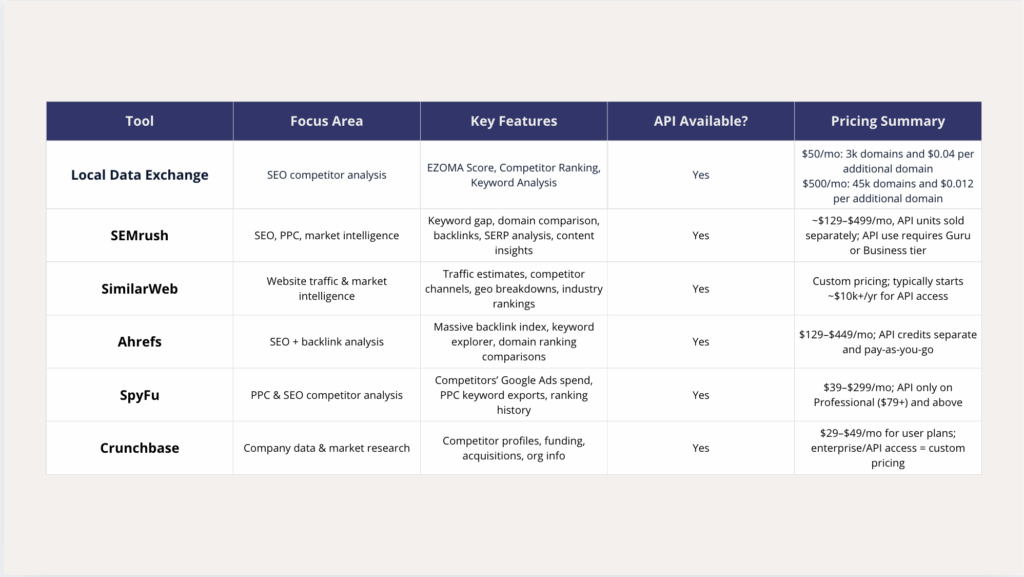
| Tool | Focus Area | Key Features | API Available? | Pricing Summary |
|---|---|---|---|---|
| SEMrush | SEO, PPC, market intelligence | Keyword gap, domain comparison, backlinks, SERP analysis, content insights | Yes (paid) | ~$129–$499/mo, API units sold separately; API use requires Guru or Business tier |
| SimilarWeb | Website traffic & market intelligence | Traffic estimates, competitor channels, geo breakdowns, industry rankings | Yes | Custom pricing; typically starts ~$10k+/yr for API access |
| Ahrefs | SEO + backlink analysis | Massive backlink index, keyword explorer, domain ranking comparisons | Yes | $129–$449/mo; API credits separate and pay-as-you-go |
| SpyFu | PPC & SEO competitor analysis | Competitors’ Google Ads spend, PPC keyword exports, ranking history | Yes | $39–$299/mo; API only on Professional ($79+) and above |
| Crunchbase | Company data & market research | Competitor profiles, funding, acquisitions, org info | Yes | $29–$49/mo for user plans; enterprise/API access = custom pricing |
| BuiltWith | Tech-stack intelligence | Competitor tech stacks, historical technology tracking | Yes | $295–$995/mo for data; API included in plans |
| Clearbit | Firmographics, market intelligence | Industry data, company lookups, enrichment | Yes | Custom pricing; typically mid-four-figure annual minimum |
| Owler | Real-time competitor tracking | News alerts, company comparisons, growth signals | Limited API (Partner program) | Free basic; Pro ~$99/mo; enterprise/API is custom |
| Brandwatch | Social listening & brand monitoring | Competitor sentiment, social analytics, share of voice | Yes | Enterprise-only, typically $12k+/yr |
| Data.ai (App Annie) | Mobile app competitor intelligence | Rankings, downloads, revenue estimates, ad insights | Yes | Enterprise-only; typically $10k+/yr minimum |
An API offers:
- Full customization for dashboards, workflows, and visualizations
- Instant data integration into existing analytics products
- Automated trend tracking across markets and locations
- Consistent data ingestion for multi-location businesses
- Better performance for high-volume SEO programs
In contrast, dashboard-only tools typically limit flexibility, restrict large-scale automation, and require manual usage which slows down enterprise and platform workflows.
Why Choose Local Data Exchange?
Local Data Exchange has earned a reputation for providing best-in-class local SEO data solutions designed for scale. With the new Competitor Analysis API, the company brings together:
- Advanced AI-powered competitor identification
- The proprietary EZOMA Score performance metric
- Location-aware search intelligence
- Enterprise-grade data architecture
- Purpose-built tools for multi-location SEO
- Deep integration support and robust documentation
Whether supporting small businesses through SaaS platforms or powering insights for national brands with thousands of locations, Local Data Exchange ensures that every API response delivers accurate, actionable, and deeply contextual local intelligence.The Competitor Analysis API is available now, with full documentation and integration details at www.localdataexchange.com/competitor-analysis-api.